Key Features and Advantages
Vara.eth offers a suite of features that address the scalability and usability challenges faced by existing blockchain solutions. These features are designed to empower developers and enhance the user experience, making Vara.eth a powerful tool for modern dApp development.
Seamless Integration with Ethereum
Vara.eth network is fully integrated with Ethereum and operates directly with native Ethereum's smart contracts. This compatibility ensures that developers can adopt Vara.eth without needing additional tokens, interfaces, or complex configurations. Users and developers can keep using Ethereum's existing tools and infrastructure they are familiar with for developing and interacting with Solidity-based smart contracts, including MetaMask, Etherscan, popular developer frameworks, environments, debugging tools, IDEs (Thirdweb, Tenderly, The Graph etc). Interaction with Vara.eth programs does not require custom ABI encoding/decoding — thanks to Sails, developers can call programs directly using familiar Ethereum tools.
Every interaction with Ethereum users and liquidity happens directly—no bridges, no wrapped tokens, no fragmented liquidity pools. Vara.eth lives within Ethereum's ecosystem, not beside it.
Parallel Execution
Vara.eth's architecture inherently supports parallel execution of programs, leveraging multiple CPUs to handle computational workloads efficiently. This capability allows developers to distribute tasks across several threads, enabling faster processing for applications like AI models, financial simulations, and complex gaming logic. By optimizing workloads for parallel execution, Vara.eth significantly boosts throughput and reduces bottlenecks, ensuring that even the most demanding applications can operate seamlessly.
Programs are inherently isolated and can run in parallel across validators. Additionally, developers can design their logic to further distribute workloads across multiple programs, enabling natural horizontal scaling.
Advanced Programming Environment
Vara.eth provides developers with a cutting-edge programming environment by combining the power of WebAssembly (Wasm) with the flexibility of Rust, a widely adopted and developer-friendly language. Wasm programs on Vara.eth enable high-performance, lightweight execution, while Rust's rich ecosystem and safety features make it easier to write, test, and maintain complex applications. Additionally, Vara.eth supports up to 2GB of memory per program (current limit), significantly exceeding Ethereum's gas-constrained execution where effective memory rarely exceeds a few MB. This combination empowers developers to create larger, more sophisticated applications, such as financial simulations, AI models, and real-time gaming systems, without being hindered by traditional blockchain limitations.
Reverse Gas Model and Flexible Gas Management
Besides the fact that Vara.eth minimizes the costs associated with decentralized computation by offloading resource-intensive tasks to its network, it also introduces a Reverse Gas model, shifting the cost of execution from users to the program itself. This approach ensures a seamless and accessible user experience, enabling broader adoption of decentralized applications (dApps).
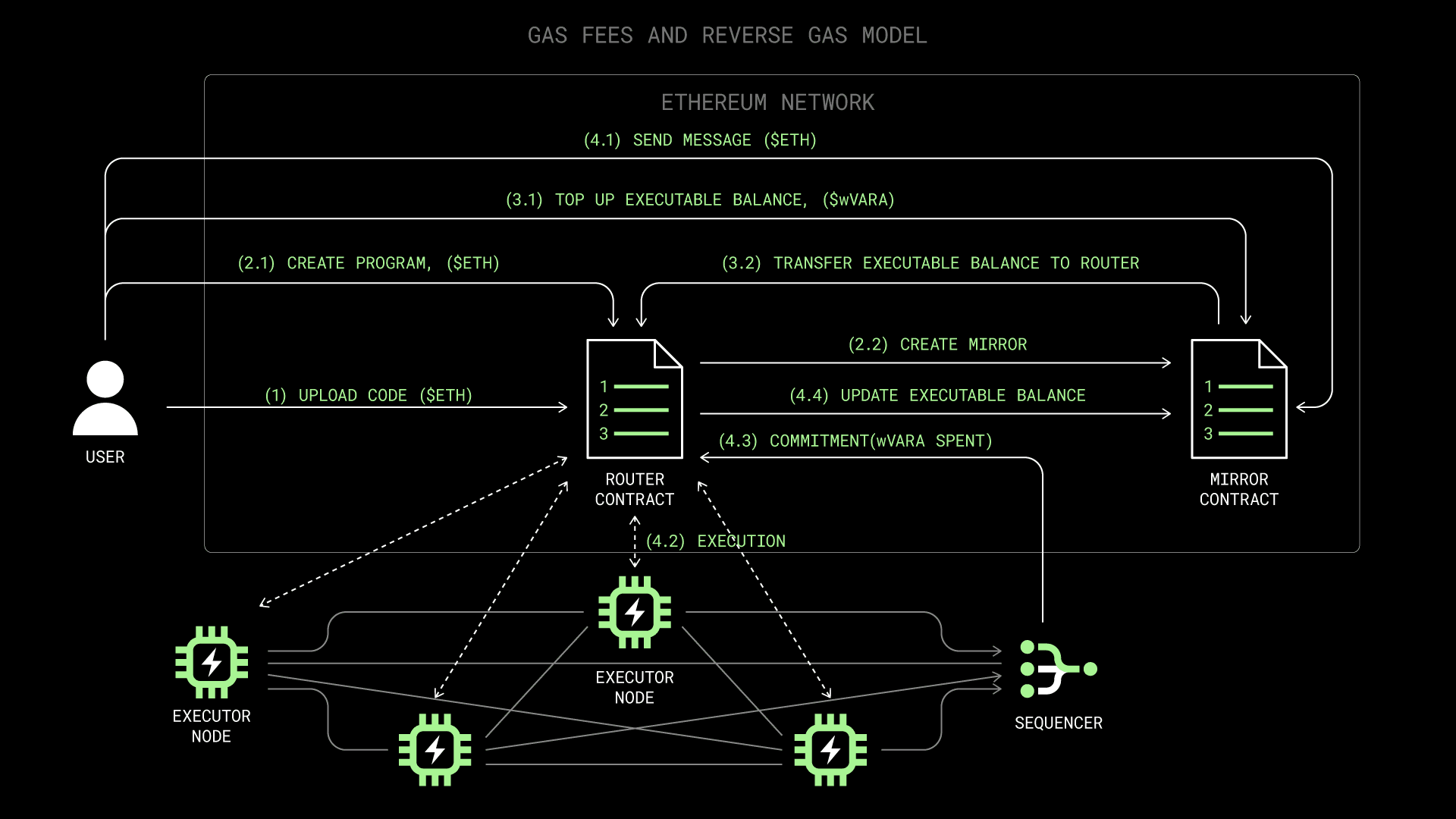 Gas Fees and Reverse Gas Model
In Vara.eth, programs maintain two types of balances:
- Executable Balance: Dedicated solely to program execution. If this balance is depleted, the program cannot process new messages until replenished.
- Free Balance: Acts as a general-purpose wallet for funds earned by the program, which can be withdrawn or converted into Executable Balance if supported by the program logic.
This model allows anyone to send messages without incurring extra compute costs beyond the base Ethereum transaction fee. The Executable Balance is consumed during execution, while funds are distributed to the network's validators as rewards. Developers can design applications that fund their Executable Balance through revenue models like user payments, fees, or even sponsorships.
The reverse gas model enhances accessibility and usability, eliminating user-side complexity while promoting scalability and efficiency for dApp creators. This makes Vara.eth particularly suited for applications that prioritize user adoption and real-time responsiveness, such as financial services, gaming platforms, and enterprise solutions.
Real-Time Computation Result and Pre-confirmations
For latency-sensitive applications, Vara.eth introduces its own technical implementation of a well-known pre-confirmation mechanism. This feature allows developers to access computation results immediately after execution, even before the transaction is finalized on-chain. Modern consensus techniques enable sub-second pre-confirmations validated by Vara.eth operators, with final settlement anchored on Ethereum. By bridging the gap between decentralized security and Web2-like responsiveness, this capability enables the development of cutting-edge applications in finance, competitive gaming, and other industries. Pre-confirmations provide early results for UX, while canonical finality still follows Ethereum's finality rules.
No Own Blocks
Unlike traditional Layer 2 solutions such as Arbitrum and Optimism, which generate and store their own blocks, Vara.eth does not create blocks. Instead, it processes transactions and program state changes directly within its network, leveraging its decentralized compute architecture. Rather than producing blocks, Vara.eth checkpoints batched program state changes to Ethereum, ensuring security while avoiding L2-style block overhead. By avoiding block creation, Vara.eth eliminates the overhead associated with block production and consensus mechanisms, reduces latency, and enables real-time computation. This design enhances scalability and allows for more efficient resource utilization, making it ideal for applications requiring instant feedback and high computational throughput.