Core Components
Vara.eth redefines decentralized computation by operating as a P2P compute network rather than a standalone blockchain. It eliminates the need to produce its own blocks or maintain a shared state, focusing solely on efficient and reliable off-chain computation.
Vara.eth relies on several key components that enable its interaction with the Ethereum ecosystem and execution of WASM-based programs. These components work together to provide a seamless, scalable, and efficient computational layer.
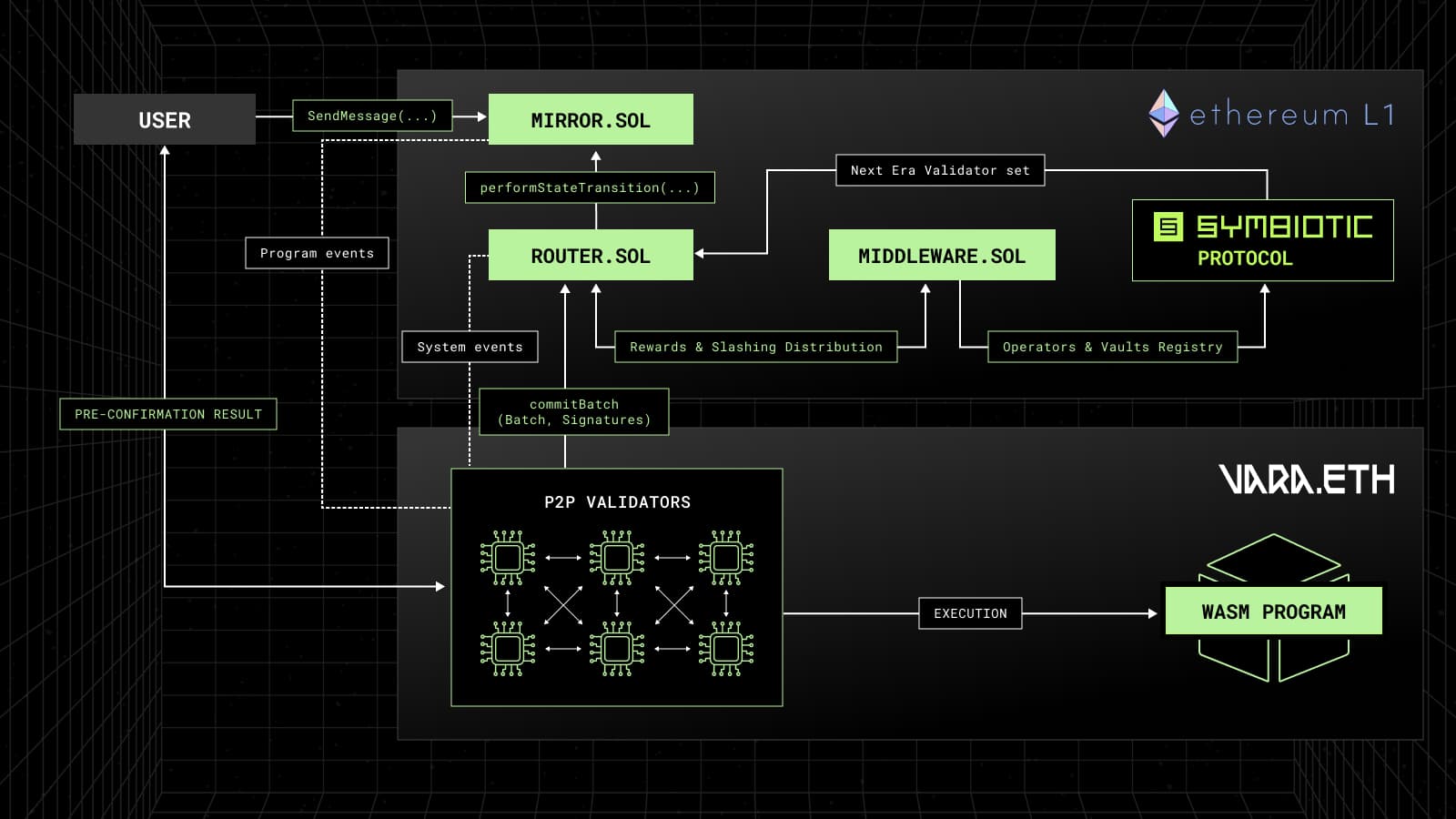
Vara.eth: Interaction with Ethereum
Gear Programs
Vara.eth programs are developed as WASM modules using the Gear Protocol framework, similar to Vara programs. These programs enable developers to implement arbitrary logic tailored to their applications.
Programs are uploaded to Ethereum as "blobs" — a form of data stored outside Ethereum's main state but accessible through archive nodes. This mechanism ensures that large datasets can be efficiently stored without burdening the Ethereum network's main state.
Each Gear program can allocate up to 2GB memory, allowing for the execution of highly complex computations, a capacity that far exceeds the stricter memory constraints of Ethereum, Optimistic Rollups, Based Rollups, and ZK Rollups. Once uploaded and verified, the program becomes available for execution within the Vara.eth network.
This one-time upload and registration mechanism ensures the security and integrity of all Gear programs while simplifying the workflow for developers, enabling seamless program reuse across multiple dApp interactions.
Router Contract
The Router Contract, written in Solidity, serves as the primary interface between Ethereum and Vara.eth. This contract plays a pivotal role in bridging off-chain computations with Ethereum's on-chain infrastructure.
Key functions of the Router Contract include:
- Program Management: Developers can upload and manage WASM programs for execution within Vara.eth.
- Result Handling: The Router Contract finalizes validator-signed execution batches and applies state updates for associated Mirror Contracts.
- Validator Coordination: The contract maintains validator keys and activates validator sets sourced from Symbiotic.
The Router Contract is a central component, deployed once for the entire Vara.eth ecosystem, ensuring a single coordination point within Ethereum.
Mirror Contract
For every uploaded Gear program, a corresponding Mirror Contract is automatically deployed on Ethereum. This contract acts as the primary interface between the on-chain and off-chain environments, enabling smooth interaction between Vara.eth and Ethereum-based components. The deployment of Mirror Contracts for each Gear program ensures modularity and scalability.
Mirror Contracts handle three primary tasks:
- Initiating Requests: They emit events that trigger the execution of WASM programs within the Vara.eth network.
- Receiving Results: Mirror Contracts receive execution results from the Router Contract and relay them to other Ethereum-based smart contracts or dApps.
- Typed Interfaces: Mirror Contracts now expose typed ABI interfaces (via Sails), allowing program inputs and outputs to be interpreted natively. This design fully replaces the older Decoder Contract model, making Mirrors the default and universal interface layer.
Validators
Validators are the backbone of the Vara.eth network — specialized nodes (also called validator nodes or executor nodes) that execute Wasm programs. These validators ensure the seamless operation of Vara.eth by maintaining redundancy, decentralization, and real-time computational capabilities. Unlike traditional blockchain validators that primarily verify transactions, Vara.eth validators actively execute computations and produce signed results. They operate without a shared storage root, focusing entirely on program execution and result validation.
The responsibilities of validators include:
- Event Detection: Validators monitor events emitted by Router and Mirror Contracts on Ethereum. These events signal the need to retrieve and execute specific Wasm programs stored in the Vara.eth network.
- Program Execution: Upon detecting a valid event, validators fetch the corresponding program, execute its logic, and produce results. These computations leverage Gear Protocol's Wasm runtime, ensuring high performance and flexibility.
- Result Signing: Validators sign computation results, which are then aggregated and finalized through the Router.
- Peer Coordination: Validators communicate through a peer-to-peer (P2P) network, ensuring fault tolerance and redundancy across the Vara.eth ecosystem.
Validators are operated by entities called operators, who are selected through Symbiotic Protocol's restaking mechanism. This mechanism aligns economic incentives with performance and reliability. Misbehavior, such as producing inaccurate results, is deterred by a robust slashing mechanism that penalizes the validator's stake. This economic accountability ensures that the network remains secure and trustworthy. Validators can also provide pre-confirmations — off-chain attestations that give users immediate feedback before final settlement on Ethereum.
Middleware
Middleware connects Vara.eth to the Symbiotic restaking protocol, ensuring that technical execution is backed by economic security. It manages operators (entities that run and maintain validator nodes), validator set elections, reward routing, and slashing enforcement. By aligning operators and stakers with transparent incentives, Middleware guarantees both accountability and resilience of the network.
In practice, Middleware coordinates the flow of value and responsibility:
- Operator Lifecycle: registering operators (entities running validator nodes), tracking their performance, and enabling or disabling them within the network.
- Validator Elections: selecting and rotating validator sets based on restaked collateral, ensuring fairness and continuity of security.
- Rewards Distribution: routing rewards both to node operators for their work and to stakers who provide collateral.
- Slashing and Discipline: enforcing penalties for misbehavior or downtime, preserving the integrity of execution.
By combining these roles, Middleware acts as the economic backbone of Vara.eth — making sure that every off-chain computation is not only technically correct but also economically secured and accountable.
Key Features and Advantages
Vara.eth offers a suite of features that address the scalability and usability challenges faced by existing blockchain solutions. These features are designed to empower developers and enhance the user experience, making Vara.eth a powerful tool for modern dApp development.
Economic Model
Next Page