Vara.eth
Revolutionizing Ethereum
Why Ethereum Needs Vara.eth
Ethereum remains the gold standard for blockchain security and DeFi composability, but it faces growing competition from faster chains like Solana, Sui, Aptos, and other high-performance networks. The platform struggles with two fundamental limitations: lack of fast finality and limited computational capacity. These constraints stem from Ethereum's monolithic architecture and an outdated virtual machine that trails modern alternatives by orders of magnitude in performance.
Ethereum's conservative approach to upgrades and its slow adaptation to emerging market demands have caused it to steadily lose ground. While Ethereum prioritizes security and decentralization, this conservatism comes at a cost—the network struggles to keep pace with the rapidly evolving needs of Web3 applications. Each year, developers increasingly turn to alternative Layer-1 chains that offer better performance, lower costs, and more flexible execution environments. If Ethereum cannot bridge this performance gap, it risks becoming less relevant in the competitive landscape of blockchain platforms.
The network's inability to process transactions in parallel, its slow finality times, and its high gas fees are critical barriers for developers and end users alike. These limitations are especially pronounced in high-demand sectors such as DeFi, gaming, and enterprise applications, where responsiveness and affordability are crucial to user adoption.
The root of these challenges lies in Ethereum's single-threaded architecture. The lack of parallel processing limits the network's computational throughput, making it difficult to handle complex or resource-intensive operations. Block confirmation time about 12 seconds introduces sensitive delays to user interactions. Finality times, averaging around 13 minutes, intensify the problem. While transactions in a block are usable after one block confirmation, applications requiring high security typically wait for finalization to ensure immutability. High gas fees (i.e expensive computations) further deter adoption, particularly for applications that require frequent or intensive computations.
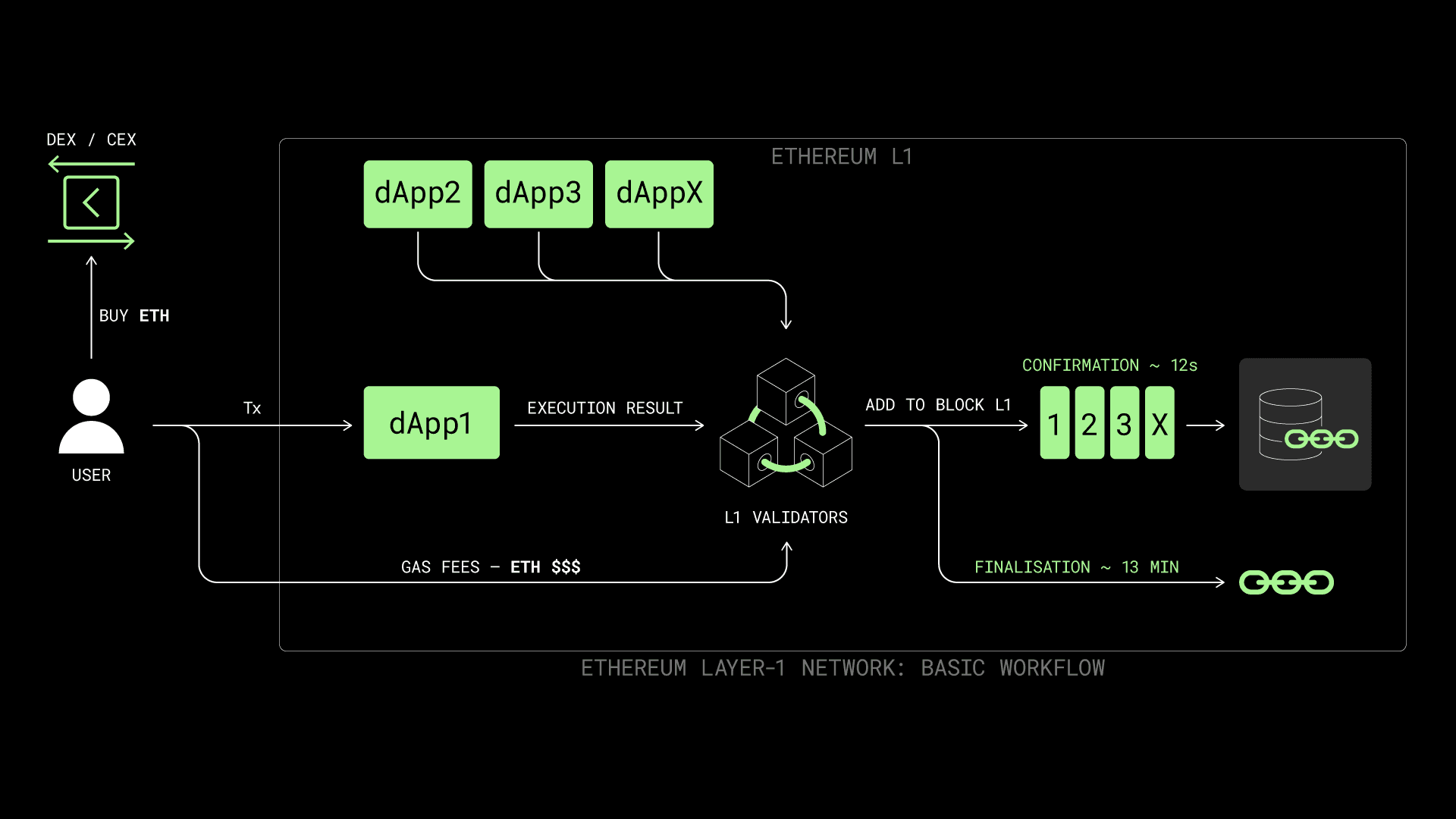
Ethereum Layer-1 Network: Basic Workflow
Rollups have attempted to address scalability, but while solving one problem, they create another. Rather than unifying Ethereum's ecosystem, rollups fragment it—operating as isolated chains where communication and composability can be more complex than cross-chain bridges. Each rollup introduces its own set of trust assumptions, sequencer dependencies, and bridging mechanisms, further splintering liquidity and developer attention across disconnected ecosystems. Security concerns and centralization risks remain largely unresolved, and the proliferation of rollups only deepens Ethereum's fragmentation problem instead of solving it.
Layer-2 solutions such as Optimistic Rollups, ZK Rollups, and Based Rollups have attempted to address these issues by offloading transaction processing from the Ethereum main chain. However, while they improve scalability, they introduce trade-offs that limit their effectiveness in certain scenarios.
Optimistic Rollups rely on a lengthy challenge period for security, delaying transaction finalization from a few hours to several days, depending on the specific rollup implementation.
ZK Rollups, while faster, impose significant computational overhead due to the resource-intensive nature of proof generation that includes a combination of complex cryptographic operations, large circuit sizes, and the need for rigorous guarantees of correctness and privacy.
Both approaches often operate in isolated environments, fragmenting liquidity and complicating interoperability.
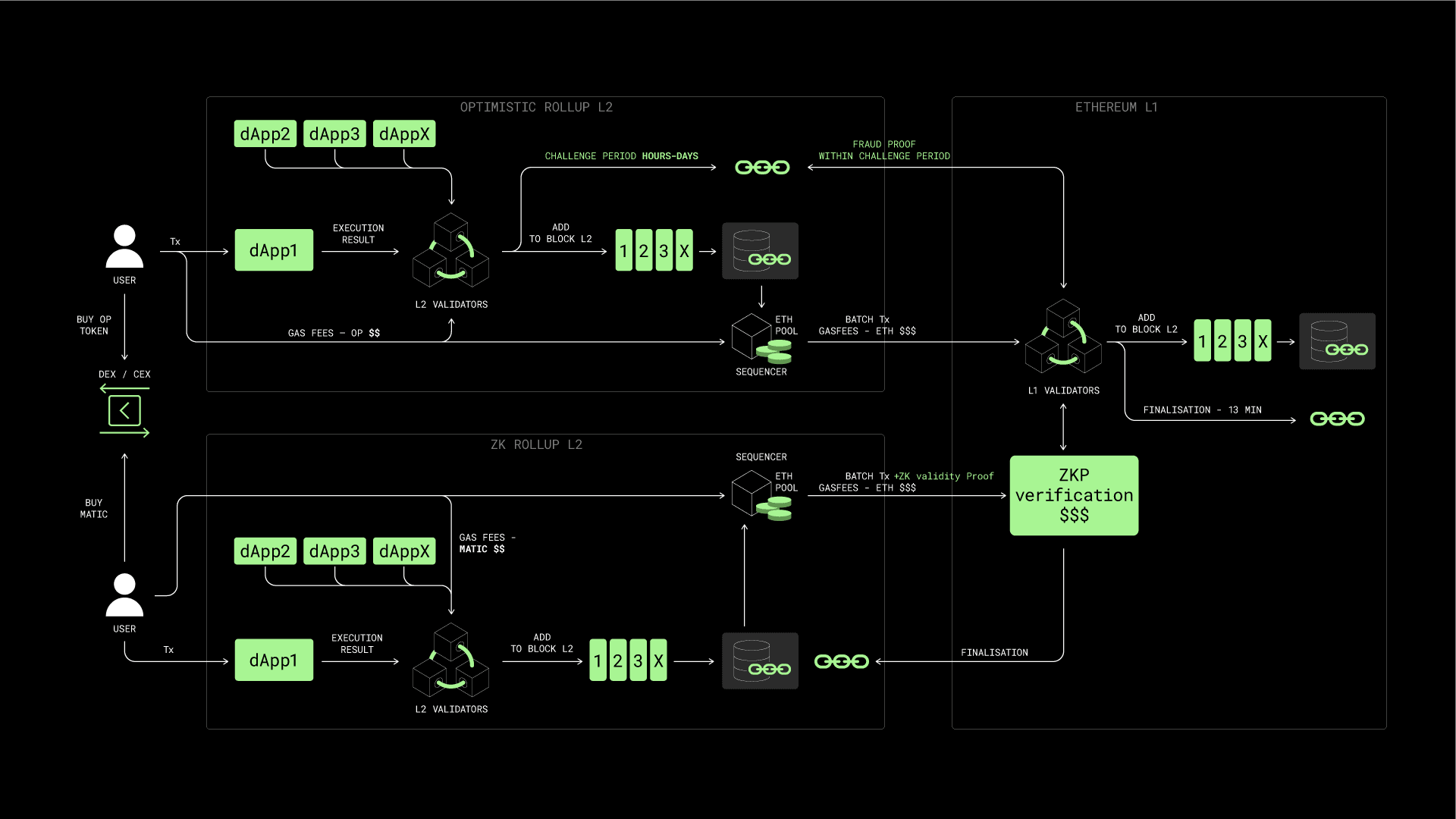
Interaction of L2 Networks with Ethereum L1: Basic Workflow
In 2023, Based rollups were proposed as an alternative, leveraging Ethereum's Layer-1 protocols for sequencing and decentralization. While these rollups reduce reliance on token-based mechanisms and simplify certain operations, they inherit scalability limitations due to shared transaction sequencing and data availability constraints. They sacrifice transaction flexibility needed for custom transaction sequencing, which can hinder their effectiveness for certain specialized use cases.
So What?
Vara.eth is an application platform built directly into Ethereum's ecosystem, powered by the battle-tested Gear Protocol engine that runs Vara Network. Rather than creating another separate chain, Vara.eth extends Ethereum itself with high-speed computation and real-time responsiveness—without bridges, without fragmenting liquidity, and without compromising on security.
Unlike rollups, where smart contracts are deployed separately on Layer-2 chains, Vara.eth keeps all operations native to Ethereum. This design allows programs running on Vara.eth to interact seamlessly with Ethereum's existing smart contracts, eliminating the need for asset bridging and avoiding liquidity fragmentation. Developers can utilize Ethereum's robust ecosystem without the additional complexity introduced by traditional Layer-2 solutions.
Another critical advantage of Vara.eth lies in its memory capacity. With up to 2GB of memory allocated per program, Vara.eth enables developers to execute resource-heavy computations that are impractical on Ethereum or Layer-2 rollups. For comparison, Ethereum and Optimistic Rollups are constrained by gas limits, which indirectly restrict memory usage to a fraction of what Vara.eth provides. Similarly, ZK Rollups, while efficient in compressing data for on-chain validation, impose strict limitations on memory to prioritize proof generation efficiency. Vara.eth's expanded memory allocation opens the door for advanced use cases such as Monte Carlo simulations, AI model training, and real-time data analysis.
The multi-threaded execution engine further sets Vara.eth apart. Ethereum and most rollups process transactions sequentially, limiting throughput and creating bottlenecks in high-demand scenarios. In contrast, Vara.eth supports parallel execution, allowing multiple computations to run simultaneously. This innovation is particularly beneficial for latency-sensitive applications, including high-frequency trading platforms, gaming environments, supply chain monitoring systems and more.
At the core of this design is Vara.eth's naturally parallel execution model: each program has its own isolated state and queue, enabling thousands of programs to be executed concurrently without coordination bottlenecks.
This parallelism extends beyond the execution layer into the very architecture of Vara.eth itself, offering powerful horizontal scalability options. While current deployments may use a unified validator set and single Router, the system is inherently designed to support multiple scaling paradigms in the future:
– Single Router with unified validator set: All validators serve all programs under one Router instance — simple and consistent.
– Multiple independent Routers (clusters): Each Router has its own validator set and serves a distinct pool of programs, enabling Vara clusters to scale horizontally — all anchored to Ethereum L1.
– Subgrouped validators within a single Router: Validators are partitioned to handle subsets of programs, reducing synchronization overhead and improving scalability within a single cluster.
These potential architectures are not mutually exclusive — they can be combined to form a modular and adaptive execution fabric, where computation scales both within programs (via threads) and across program clusters. The result is a compute network that grows with demand while preserving Ethereum-level security and canonical finality.
Cost efficiency is another defining feature of Vara.eth. By offloading intensive computations to its decentralized network, Vara.eth reduces the costs associated with executing complex logic. Additionally, it introduces a reverse gas model, where developers can cover transaction fees for users. This approach provides a frictionless experience similar to Web2 applications, enabling developers to design user-friendly dApps that prioritize accessibility and adoption.
Vara.eth also enhances user and developer experience by allowing off-chain transactions with pre-confirmations. Unlike Layer-2 solutions that often delay finality due to challenge periods or proof generation, Vara.eth delivers immediate computation results before they are finalized on Ethereum. This capability ensures real-time responsiveness while maintaining the security guarantees of blockchain-based systems.
The use of Rust as the primary programming language for Vara.eth programs further differentiates it from traditional Ethereum development. Rust is a widely used, general-purpose language known for its performance and safety, offering a robust ecosystem that is accessible to a broad range of developers. In contrast, Solidity, Ethereum's native language, is blockchain-specific and requires a steeper learning curve. By leveraging Rust, Vara.eth simplifies the development process while enabling the creation of more powerful and maintainable applications.
In summary, Vara.eth addresses Ethereum's limitations and surpasses the capabilities of Layer-2 solutions by offering seamless Ethereum integration, expanded memory capacity, parallel execution, cost-efficient processing, and developer-friendly tools. By bridging the gap between Ethereum's security and the performance demands of modern applications, Vara.eth is paving the way for the next generation of decentralized applications across industries such as finance, gaming, AI tools, math modeling, supply chain management and many more.
Finally, the architectural foundation of Vara.eth is inherently chain-agnostic. While the current implementation is deeply integrated with Ethereum, the same execution model can be ported to other Layer-1 protocols. In this way, Vara.eth becomes not only an application platform for Ethereum, but a general-purpose execution layer capable of extending scalable execution power to any chain that supports smart contract anchoring and event propagation.
Vara.eth doesn't compete with L2s—it shows that Ethereum doesn't need new chains to scale. It needs a powerful application layer built on proven technology.
Introduction
Overview of Vara.eth
Key Features and Advantages
Vara.eth offers a suite of features that address the scalability and usability challenges faced by existing blockchain solutions. These features are designed to empower developers and enhance the user experience, making Vara.eth a powerful tool for modern dApp development.